Grounds for divorce in Malaysia
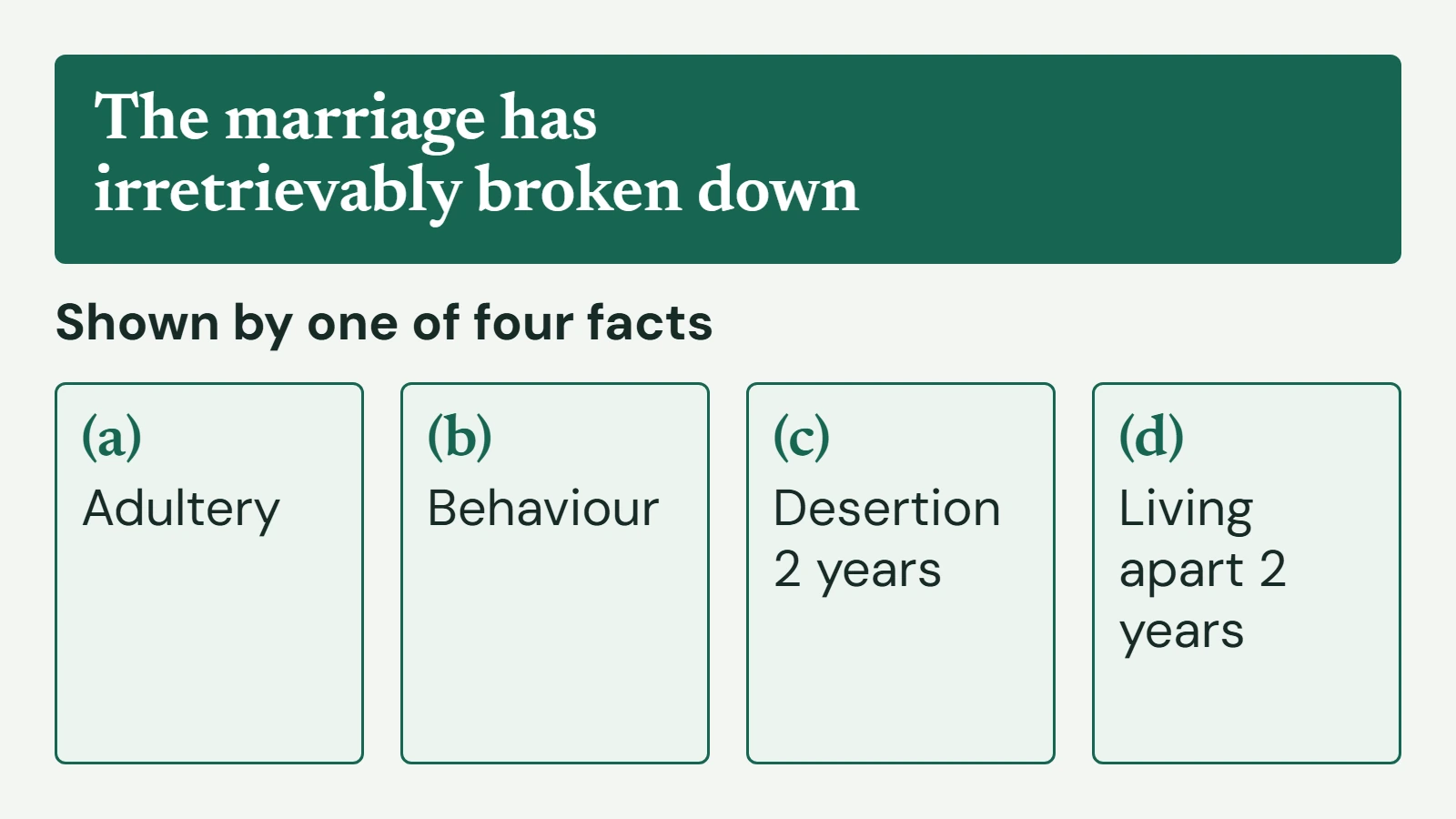
Under Act 164 the only ground for a single petition is that the marriage has irretrievably broken down (section 53). The court looks at four facts in section 54: adultery, unreasonable behaviour, two years' desertion, or two years living apart. A joint petition under section 52 needs no ground proved.
What are the grounds for divorce in Malaysia, and what must the court find?
Section titled “What are the grounds for divorce in Malaysia, and what must the court find?”For non-Muslim couples, divorce is governed by the Law Reform (Marriage and Divorce) Act 1976 (Act 164).
There is only one ground. Section 53(1) says either spouse may petition for divorce on the ground that the marriage has irretrievably broken down. That means it cannot be repaired. The court must, so far as it reasonably can, inquire into the facts alleged as causing the breakdown. If it is satisfied that it is just and reasonable, it makes a decree.
To test the breakdown, section 54(1) tells the court to look at one or more of four facts:
- Adultery. The other spouse has committed adultery and the petitioner finds it intolerable to live with them (section 54(1)(a)).
- Behaviour. The other spouse has behaved in such a way that the petitioner cannot reasonably be expected to live with them (section 54(1)(b)).
- Desertion. The other spouse has deserted the petitioner for a continuous period of at least two years immediately before the petition (section 54(1)(c)).
- Living apart. The couple have lived apart for a continuous period of at least two years immediately before the petition (section 54(1)(d)).
The “petitioner” is the spouse who files, and the “respondent” is the other spouse. These two words are used throughout the Act and in court papers. You do not need all four facts. One that the court accepts, together with the wider picture, can be enough.
Section 54(2) adds a second step. The court must consider all the circumstances, including the conduct of both spouses and how the interests of any child or of either spouse would be affected if the marriage ended. If it would be wrong to dissolve the marriage, it must dismiss the petition.
A joint petition is different. Under section 52, if both spouses agree the marriage should end, they may present a joint petition. The court must be satisfied that both freely consent and that proper provision is made for the wife and for the children’s support, care and custody. The section does not ask anyone to prove a ground. See joint or contested divorce and the single petition guide for how each route runs.
Finally, section 50 sets a two-year bar. No petition may be presented before two years from the date of the marriage. A judge may allow an earlier petition on the ground of exceptional circumstances or hardship suffered by the petitioner, and must have regard to any child’s interests and to whether there is a reasonable probability of reconciliation. Section 50(3) says matters that happened in the first two years can still be relied on in a petition filed later.
Are money problems or poor communication a ground for divorce?
Section titled “Are money problems or poor communication a ground for divorce?”Not on their own. Money worries and silence between spouses are real and painful, but Act 164 does not list money trouble or poor communication as a ground or as one of the four facts. They matter only if they are tied to the statutory test, usually section 54(1)(b): has the other spouse behaved in a way that the petitioner cannot reasonably be expected to live with?
Frequent arguments do not automatically prove that a marriage has broken down. What helps is a clear record of the underlying conduct. Write down:
- The conduct. What actually happened, in specific terms, for example hiding debts, refusing to contribute, or cutting off all discussion.
- How long it has gone on. Dates, and whether it is repeated or a single event.
- Its effect. What it did to you, to the household and to the children.
- Attempts to resolve it. Conversations, counselling, family help, changes you asked for and what followed.
Yong Jin Man’s estimate is that money plays a part in about eight or nine out of ten divorces he sees. This is his observation, not a statutory rule.
Is a sexless marriage a ground?
Section titled “Is a sexless marriage a ground?”The Act does not list lack of sexual relations as a ground by itself, and it does not define it as one of the section 54 facts. It is not one of the four facts. A sexless marriage is assessed on its whole circumstances, usually under section 54(1)(b): what lies behind it, how long it has lasted, what the effect has been and what was tried. Whether those facts qualify depends on the case.
Does suspicion, flirting or an emotional affair count as adultery?
Section titled “Does suspicion, flirting or an emotional affair count as adultery?”Section 54(1)(a) needs two things: that the respondent has committed adultery, and that the petitioner finds it intolerable to live with the respondent. Suspicion is not proof. Suggestive messages do not conclusively prove adultery either. Accusations alone are not enough, so keep any relevant evidence lawfully and ask a lawyer what must be shown. Other behaviour that falls short of adultery may still be considered under section 54(1)(b).
Section 58 deals with how adultery is pleaded. Where a petition alleges adultery, the petitioner must name the alleged third party as a co-respondent, unless the court excuses this on special grounds. The petition may ask that the co-respondent pay damages. If the court is satisfied that adultery was proved, it may award damages as it thinks fit, but the award cannot include any exemplary or punitive element. That means it cannot be meant to punish. The court can discharge the co-respondent if the evidence against them is not enough. Read more in our adultery guide.
Does social media matter?
Section titled “Does social media matter?”Comparing your marriage with other people’s online lives is not a ground for divorce, however much it may feed resentment at home. Nor is a partner’s wish for a lifestyle seen online. The legal question stays the same: has the marriage irretrievably broken down, and is a section 54 fact established?
Particular conduct linked to social media may be relevant under section 54(1)(b) if it makes living together unreasonable. The court looks at what actually happened, not at the fact that comparison exists.
Posts are not automatic proof of a happy marriage, of adultery, of how a child is cared for or of anyone’s money. If online material may be used in your case, keep it properly: save the original, note the date and source, and ask a lawyer about authenticity and whether the court will accept it.
Do I have to try to reconcile first?
Section titled “Do I have to try to reconcile first?”Often, yes. Section 106 says that, except for petitions under sections 51 and 52, a person must first refer the matrimonial difficulty to a conciliatory body, which must certify that it failed to reconcile the couple. There are listed exceptions, such as a spouse who cannot be traced or lives abroad. Section 55(2) lets the court pause a case if there seems a reasonable possibility of reconciliation, and section 57(2) requires the petition to state what steps were taken. See marriage counselling for how the referral works.
From practice: what Yong Jin Man sees
Section titled “From practice: what Yong Jin Man sees”Yong Jin Man is a divorce lawyer. These points are his experience, not statutory rules.
- Arguments are not the test. In his view, frequent arguments should not be assumed to prove breakdown. What matters is the behaviour underneath them.
- Document the conduct. He advises recording what happened, how long it lasted, its effect and what was tried to resolve it.
- Money is common. He estimates that money is involved in eight or nine out of ten divorces he sees. It is his observation, not a statistic.
- Pause before filing. When a client is very emotional, he asks them to stop and think before a petition is filed.
- Online posts are not proof. He treats social media comparison as social commentary, not a legal proposition.
A worked example
Section titled “A worked example”This example is made up to show how the rules apply. It is not a real case.
Dev says: “We argue about money all the time.” He wants to know whether that is enough to divorce Mei.
- Arguing about money is not a ground by itself. The only ground is that the marriage has irretrievably broken down (section 53(1)), and the court tests that against the four facts in section 54(1).
- Dev starts with the dates. They married five years ago, so the two-year bar in section 50 is not a problem.
- He writes down the conduct: Mei took out loans in his name without telling him, and refuses to discuss the family budget. It began three years ago and has repeated each year.
- He records the effect and the attempts to fix it. The couple fell behind on rent, and they argued in front of the children. He asked her to see a counsellor twice and she declined.
- The fact that could apply is section 54(1)(b): that Mei has behaved in such a way that Dev cannot reasonably be expected to live with her. He would have to show that conduct, not just that they argue.
- The court then considers all the circumstances, including both spouses’ conduct and the children’s interests (section 54(2)), before deciding whether it is just and reasonable to grant a decree.
Sources
Section titled “Sources”- Law Reform (Marriage and Divorce) Act 1976 (Act 164), official text, Attorney General’s Chambers. Sections 50, 52, 53, 54, 55, 58 and 106 read from this text.
- Court judgment portal (eJudgment).
What recent decisions show
| Date | Subject | Outcome |
|---|---|---|
| — | The court found the marriage had irretrievably broken down with responsibility shared equally, dissolved it with a decree nisi to become absolute in three months, ordered the matrimonial home and two City Plaza units sold within nine months with the combined net proceeds divided 55% to the wife and 45% to the husband, and ordered the husband to pay the wife spousal maintenance of RM10,000 a month plus her medical insurance and half of her outstanding debt-management (AKPK) debt. No order as to costs. | |
| — | The marriage was dissolved and the decree nisi made absolute immediately, because the wife's section 54(1)(b) petition (irretrievable breakdown) was agreed by the husband at trial. The parents have joint guardianship, the wife has sole custody, care and control of the child with reasonable access for the husband, and the husband must pay RM2,000 a month child maintenance (rising 5% every two years until the child finishes her first degree) plus half of the child's education, medical, insurance and activity costs, and RM30,000 costs to the wife. The court dismissed the husband's cross-petition claims at paras 164(d) to (k) (declarations about the family business and joint bank accounts) for lack of proof or because both sides said those were not matrimonial assets. |