Late penal notice refused
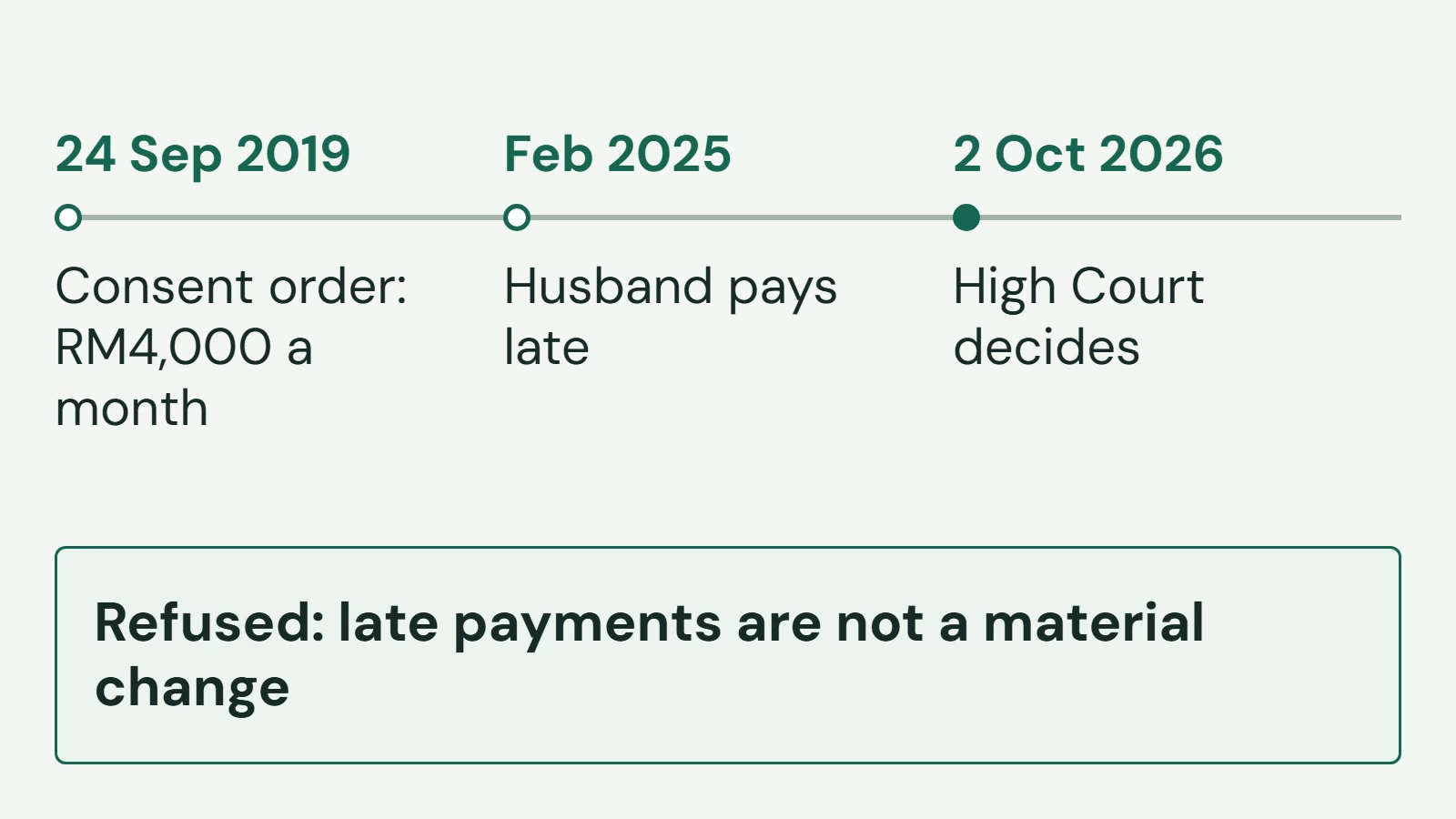
On 2 October 2026 the Shah Alam High Court refused a wife's request to vary a 2019 divorce consent order into a lump sum and to add a penal notice. Late payments from a husband in financial difficulty were not a material change, and a term the husband had opposed could not be added six years on.
Can I change a consent order years later to add a penal notice?
Section titled “Can I change a consent order years later to add a penal notice?”Not easily. In this Shah Alam case a wife asked the court to turn monthly maintenance under a 2019 consent order into a lump sum and to add a penal notice (a warning that disobeying the order can lead to committal). The court dismissed both requests, with costs.
| Item | Detail |
|---|---|
| Case number | BA-33-247-04/2018 (S.D.C.M. v P.R.) |
| Court | High Court of Malaya, Shah Alam (Family Division) |
| Judge | Indra Nehru Savandiah |
| Decided | 2 October 2026 (written grounds dated 5 November 2026) |
| Issue | Whether a 2019 consent order should be varied under section 83 of the Act |
| Outcome | Application dismissed with costs |
What happened
Section titled “What happened”The couple married in 1990. Their marriage was dissolved on 24 September 2019 by a consent order that included monthly maintenance of RM4,000 for the wife. The husband paid regularly until February 2025, when he said he ran into financial difficulty. The wife applied to vary the order so that maintenance was paid as one lump sum or in two instalments (she calculated RM1.2 million over 25 years) and asked for a penal notice to be endorsed. He said his payments had been late, not refused, and that he had always opposed a penal clause.
What the court decided
Section titled “What the court decided”- Here, late payments were not a material change. Section 83 allows a maintenance order to be varied only if it was based on a misrepresentation or mistake of fact, or if there has been a material change in circumstances, and the applicant must prove it. The husband’s difficulty was explained and he promised to pay.
- This consent order was not re-written. The 2019 terms were agreed by represented parties. In this case the court said a party who is unhappy should apply to set the order aside, not vary it to add terms nobody agreed.
- No penal notice. The husband opposed a penal notice when the order was drawn up. Adding one six years later would go against the parties’ intention, and the court did not accept that the wife only realised its value after six years.
- A gentler route exists. The court said that if the aim is to enforce payment, a judgment debtor summons is a more harmonious option than committal.
If this were you
Section titled “If this were you”This scenario is made up to show how the ruling applies. It is not a real case.
Grace’s divorce order, made six years ago by consent, gives her RM4,000 a month. Her former husband now pays late. She asks the court to turn it into a lump sum and add a penal notice.
- Late payments may not be a material change. Section 83 needs a mistake or a material change, and she must prove it.
- A consent order may not be rewritten. In this case the court said that, if unhappy with the terms, the route is to set the order aside.
- The penal notice may not be added. In this case the husband had opposed one when the order was drawn up.
- Six years later may be too late to change the bargain. In this case the court held the parties to what they agreed.
- A gentler route exists. The court said a judgment debtor summons is a more harmonious option than committal.
Why it matters for you
Section titled “Why it matters for you”Settle the enforcement terms of a consent order at the start. If you want the order enforceable by committal, ask for that when it is drawn up, because in this case the court held the wife to the bargain six years later. Falling behind on payments, or being owed money, is a matter for enforcement, not automatically a reason to rewrite the order. Another court on other facts may decide differently. Compare the Melaka ruling on penal notices in a custody order.