Your first divorce consultation
Use the first meeting to settle five points from Act 164: whether you can petition yet (section 50), joint or single petition (sections 52 to 54), whether you need a tribunal certificate (section 106), what the petition must state (section 57), and children and money. Leave with agreed next steps.
What should you ask and bring to a first divorce consultation?
Section titled “What should you ask and bring to a first divorce consultation?”Ask the questions that decide your route, and bring the facts the petition must state. For non-Muslim couples the route is set by the Law Reform (Marriage and Divorce) Act 1976 (Act 164).
The government’s divorce procedure page gives the outline: file a petition at the High Court, either joint or contested; a mention and trial; a provisional order (decree nisi); and after three months an application for the final decree. In contested cases you must refer to the marriage tribunal at the National Registration Department (JPN), except in certain cases. A first meeting turns that outline into your plan.
What questions decide your route?
Section titled “What questions decide your route?”Can I petition now?
- Why it matters: No petition within two years of the marriage unless a Judge gives leave for “exceptional circumstances or hardship”
- Section of Act 164: Section 50
Joint or single petition?
- Why it matters: A joint petition needs both spouses to freely consent and proper provision for the wife and the children
- Section of Act 164: Section 52
Which fact will I rely on?
- Why it matters: The ground is irretrievable breakdown, shown by adultery, behaviour, two years’ desertion or two years apart
- Section of Act 164: Sections 53 and 54(1)
Do I need a tribunal certificate?
- Why it matters: A conciliatory body must certify failed reconciliation, unless an exception applies
- Section of Act 164: Section 106
What must the petition say?
- Why it matters: Marriage and children details, jurisdiction, past proceedings, allegations, agreements or proposals, relief sought
- Section of Act 164: Section 57
What happens with the children?
- Why it matters: The court puts the child’s welfare first
- Section of Act 164: Section 88(2)
What happens with money and property?
- Why it matters: The court can divide assets and order maintenance
- Section of Act 164: Sections 76 to 78
How final is the decree?
- Why it matters: A decree nisi cannot be made absolute before three months unless the court shortens it
- Section of Act 164: Section 61(1)
Our guide on joint or contested divorce explains the two routes.
What should you bring?
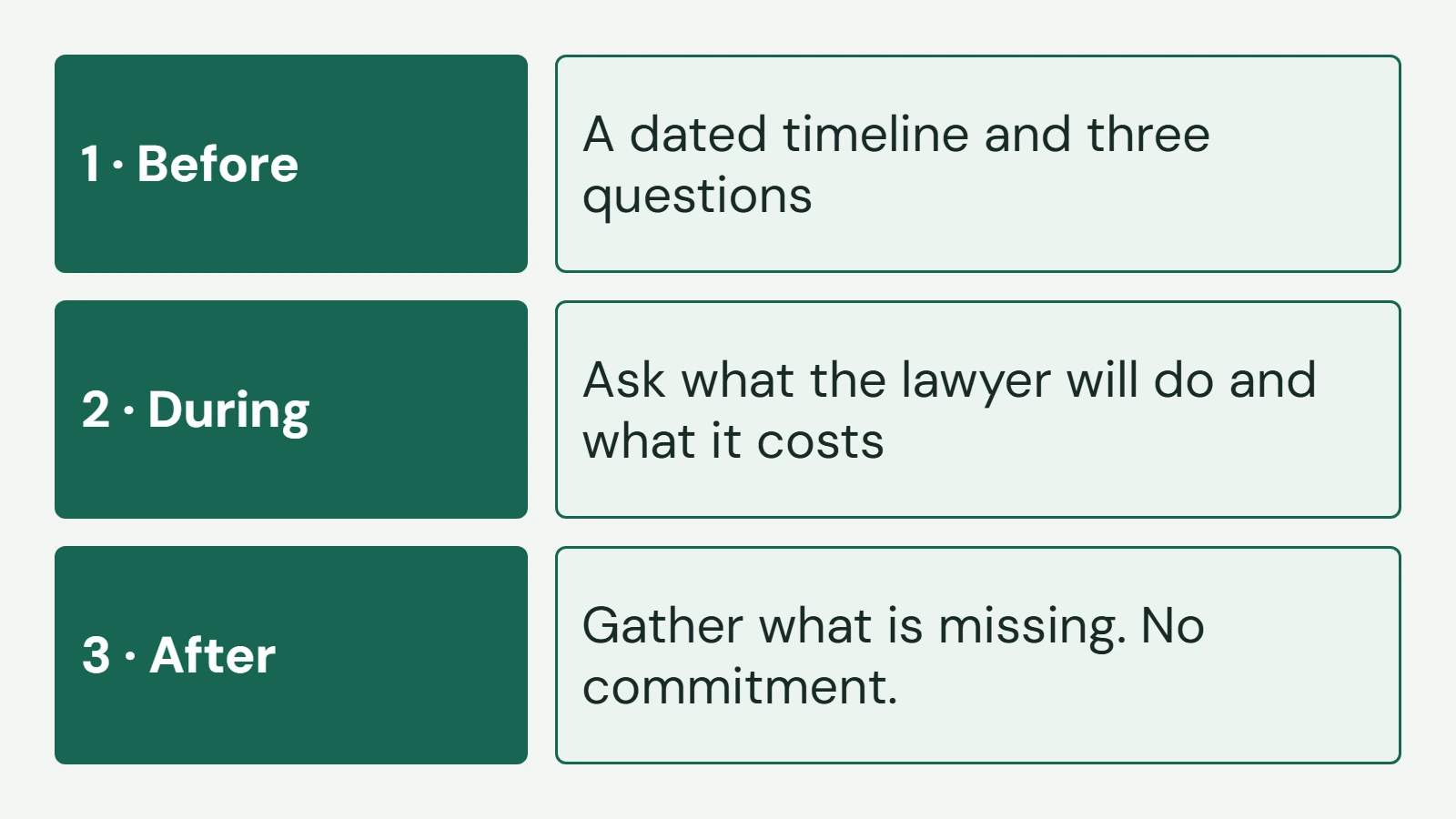
Section titled “What should you bring?”Bring a short dated timeline, three questions you most want answered, and the documents listed in our consultation documents checklist. The most useful are proof of the marriage, your children’s details and your income and expense records. Mark anything uncertain instead of guessing. The lawyer can say what evidence the facts need.
How do you check who is advising you?
Section titled “How do you check who is advising you?”Before you share sensitive records or pay, confirm the practitioner’s identity, qualifications and the scope of the service. The Malaysian Bar’s website lists a Legal Directory for this purpose. Ask what the service covers, how documents will be kept safe and how fees are set. Our costs and questions guide lists points to raise.
The Legal Aid Department lists divorce and custody among the civil proceedings it can help with, for those who qualify.
How should the meeting run, step by step?
Section titled “How should the meeting run, step by step?”- State your situation in a few sentences: marriage date, children, where each spouse lives.
- Ask whether section 50 allows you to petition now.
- Ask which of the four section 54(1) facts fits your timeline, and what evidence it needs.
- Ask whether you need a tribunal certificate or fall within a section 106 exception.
- Ask for unfamiliar terms in plain language.
- Ask what the petition will say about the children and money under section 57(1)(e).
- Ask what the lawyer will and will not do, and what it will cost.
- Before you leave, write down what is missing, who gets it and the next step.
Read more in our case on a withdrawn petition.
From practice: what Yong Jin Man sees
Section titled “From practice: what Yong Jin Man sees”Yong Jin Man’s closing advice is useful before you ever meet a lawyer. It is his experience, not a rule.
- Agree what you can first. In his view a joint petition works like a signed contract. Before lawyers are involved, spouses can try to reach terms on the property, the children and life after the divorce, so the lawyer’s job is to put an agreement into proper form.
- Keep talking. He says communication is the most useful habit. If you can avoid a contested petition, avoid it, because it is longer and costlier.
- Mind how lawyers are used. Some clients tell him that talking only through lawyers makes the other spouse defensive: “Why suddenly you want a lawyer to talk to me?” Raise this at the first meeting and ask how the lawyer will handle contact.
- Plan for later. Think about property, children and life afterwards as a whole, as you would when planning a wedding.
A worked example
Section titled “A worked example”This example is made up to show how the rules apply. It is not a real case.
Priya and Arun are non-Muslims, married 18 months. Both agree the marriage is over. They have no children. Priya books a consultation.
- She brings her marriage certificate, a dated timeline and three questions: Can we file now? Do we need a tribunal? What happens to our joint savings?
- The lawyer points to section 50: a petition is not allowed before two years from the marriage, unless a Judge allows it for exceptional circumstances or hardship under section 50(2).
- The lawyer explains section 52: after two years they can present a joint petition if both freely consent and proper provision is made.
- Priya asks about section 106. A joint petition under section 52 is outside the tribunal requirement.
- For the savings, the lawyer explains that section 76 lets the court divide assets acquired by joint efforts, and what Priya’s records need to show.
- Priya writes down the agreed next steps: gather bank statements, confirm the exact date of marriage, and decide whether to wait for the two-year date or apply for leave.
What next?
Section titled “What next?”To see where the first meeting sits in the whole case, read the divorce procedure guide.
Watch: videos on this topic
Section titled “Watch: videos on this topic”Social Media Is Ruining Marriages, Say Divorce Lawyers [Back To Basics]
- Channel: Mr Money TV
- Length: 46:49
- Uploaded: 9 Oct 2026
Lawyer Kokila Vaani - EP2 Navigating Divorce Options and Mental Health Support - Varnam Exclusive
- Channel: Varnam Malaysia
- Length: 13:17
- Uploaded: 21 Aug 2024
Sources
Section titled “Sources”- Law Reform (Marriage and Divorce) Act 1976 (Act 164), Attorney General’s Chambers: sections 50 to 54, 57, 61, 76 to 78, 88 and 106.
- Malaysia.gov.my: divorce procedures for non-Muslim couples.
- Legal Aid Department and Malaysian Bar.
- Court judgments, eJudgment portal, through the links in the table.